
Have you ever wondered whether to write desert or dessert? These two words look almost identical, but they have very different meanings. One describes a dry area of land, while the other refers to the sweet food people enjoy after a meal. Using the wrong spelling can make your sentence confusing, especially when writing messages, school assignments, or professional content.
The easiest way to understand the difference is to remember that a desert is a place, while a dessert is something sweet to eat. For example, the Sahara is a famous desert, but chocolate cake is a delicious dessert. These words also have different pronunciations depending on their meanings. In this guide, you will learn how to use desert and dessert correctly, understand their pronunciation, explore practical examples, and discover simple memory tricks that will help you avoid common spelling mistakes.
Quick Answer
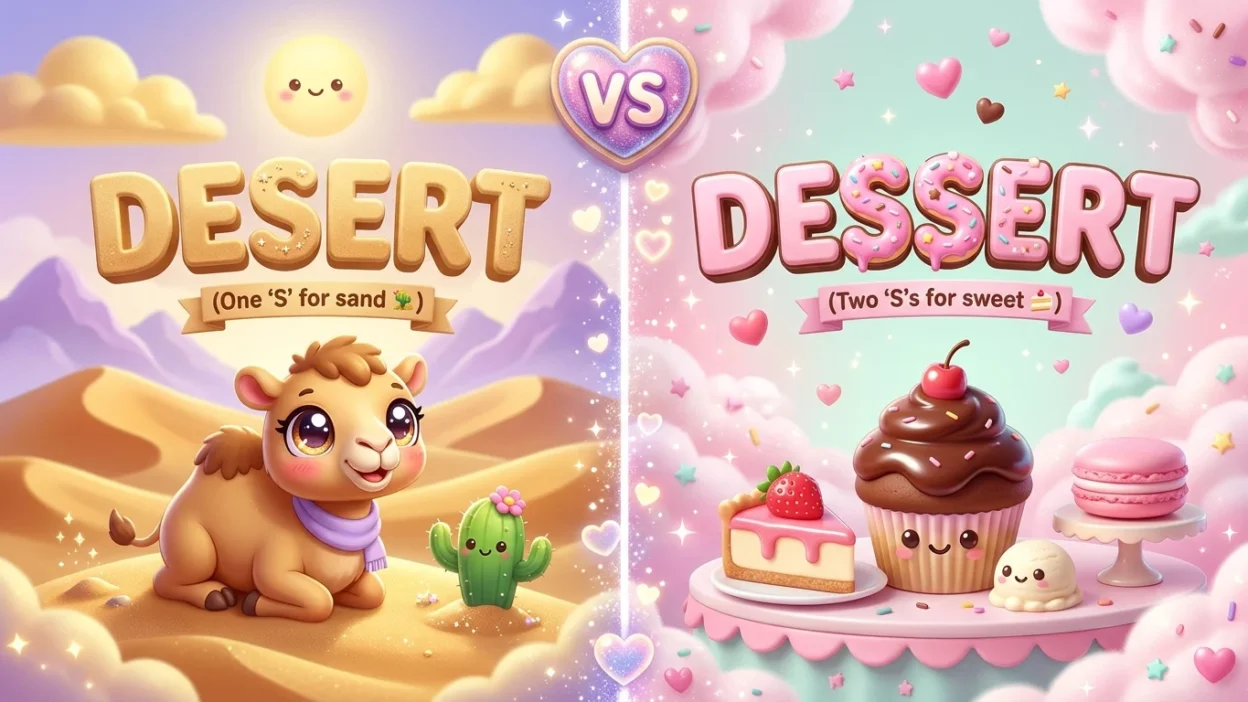
Desert usually means a dry, sandy or rocky region that receives very little rainfall. It can also mean to abandon someone or something. Dessert means a sweet food served after a meal, such as cake, ice cream, or pudding. Remember: dessert has two S’s because you may want a second serving!
Why Do People Confuse Desert and Dessert?
People often confuse desert and dessert because their spellings are almost identical. Both words contain the same letters, but dessert has one extra S.
Their pronunciation can also create confusion because the noun desert and the word dessert have different stress patterns.
- Desert (dry land): Pronounced DEZ-ert.
- Dessert (sweet food): Pronounced dih-ZURT.
The extra S in dessert helps distinguish the sweet treat from the dry landscape.
Another reason for confusion is that desert has more than one meaning. It can describe a dry region or the act of leaving someone behind.
Understanding the context and pronunciation makes choosing the correct word much easier.
What Does Desert Mean?
Desert is a noun that describes a large area of land receiving very little rainfall. Deserts can be extremely hot or extremely cold. They often have limited vegetation because of their dry conditions.
Some famous deserts include the Sahara Desert, the Arabian Desert, and the Gobi Desert.
For example:
- The Sahara Desert is located in North Africa.
- Many animals have adapted to life in the desert.
- The travelers crossed the dry desert.
- Very few plants grow in some desert regions.
The word desert can also be a verb meaning to abandon someone or leave a place.
For example:
- The soldiers refused to desert their positions.
- He did not want to desert his family.
- The village was deserted after the storm.
How Is Desert Used in a Sentence?
The word has two common meanings.
As a noun: The desert was extremely hot during the afternoon.
Here, desert describes a dry geographical area.
As a verb: The captain warned the soldiers not to desert their duties.
Here, desert means to abandon or leave something behind.
As an adjective in a compound phrase: The researchers studied desert plants.
Here, desert describes plants that grow in dry environments.
What Does Dessert Mean?
Dessert is a noun that refers to sweet food usually served after the main meal. It can include cakes, cookies, ice cream, pastries, fruit-based dishes, and puddings.
People often enjoy dessert at restaurants, family gatherings, birthday parties, and celebrations.
For example:
- We ordered chocolate cake for dessert.
- My favorite dessert is strawberry ice cream.
- She prepared a delicious dessert for dinner.
- Would you like some dessert after your meal?
Unlike desert, the word dessert is associated with food, sweetness, and enjoyable treats.
How Is Dessert Used in a Sentence?
Here are some common situations where you can use the word.
After dinner: We enjoyed chocolate pudding for dessert.
At a restaurant: The waiter brought the dessert menu.
At a celebration: Everyone loved the birthday dessert.
At home: My mother made a delicious dessert for the family.
When making a choice: Which dessert would you like to try?
Whenever you are talking about sweet food served after a meal, dessert is the correct spelling.
Desert vs Dessert: Comparison Table
| Feature | Desert | Dessert |
|---|---|---|
| Meaning | A dry region; also means to abandon | Sweet food served after a meal |
| Part of speech | Noun or verb | Noun |
| Spelling | One S | Two S’s |
| Pronunciation (noun) | DEZ-ert | dih-ZURT |
| Common context | Geography, travel, abandonment | Food, restaurants, celebrations |
| Example | The camel crossed the desert. | We ate cake for dessert. |
| Memory clue | Dry land | Sweet treat |
The biggest difference is simple: desert refers to a dry place, while dessert refers to sweet food.
When Should You Use Desert or Dessert?
Choosing the correct word becomes easier when you understand what your sentence describes.
Use Desert When Talking About Dry Land
Use desert when referring to a dry geographical area with very little rainfall.
Examples:
- The camel walked across the desert.
- The Sahara is the world’s largest hot desert.
- Desert animals have special survival abilities.
- The travelers spent two nights in the desert.
You can also use desert as a verb when describing someone abandoning a person, place, or responsibility.
Example: The soldier refused to desert his team.
Ask yourself: Am I talking about a dry region or abandoning something? If yes, use desert.
Use Dessert When Talking About Sweet Food
Use dessert when referring to sweet food usually served after lunch or dinner.
Examples:
- I ordered ice cream for dessert.
- Chocolate cake is my favorite dessert.
- She prepared a delicious dessert for the guests.
- We shared a dessert after dinner.
Ask yourself: Am I talking about something sweet to eat? If yes, use dessert.
Desert vs Dessert: 12 Examples
Here are 12 practical examples to help you understand how both words work in everyday English.
Examples With Desert
1. The Sahara is a famous desert.
The sentence describes a large, dry geographical region.
2. Camels can survive in the desert.
The word refers to a dry environment where camels live.
3. The travelers crossed the desert during the day.
The sentence describes a journey through a dry region.
4. Very little rain falls in this desert.
The word describes an area with low rainfall.
5. The soldier refused to desert his fellow soldiers.
Here, desert means to abandon or leave behind.
6. The old village was deserted after the flood.
Here, deserted means abandoned or left empty.
Examples With Dessert
7. We ate chocolate cake for dessert.
The sentence refers to a sweet food served after a meal.
8. My favorite dessert is vanilla ice cream.
The word describes a sweet treat.
9. She made a delicious dessert for her guests.
The sentence describes sweet food prepared for visitors.
10. Would you like dessert after dinner?
The speaker is asking whether someone wants something sweet.
11. The restaurant offers several delicious desserts.
The word refers to different sweet food options.
12. We shared a strawberry cheesecake for dessert.
The sentence describes a sweet dish enjoyed after a meal.
Common Mistakes With Desert and Dessert
Even experienced English speakers sometimes make spelling mistakes with these words. Here are some common errors and their corrections.
Mistake 1: Using Desert When Talking About Sweet Food
Incorrect: We ordered chocolate cake for desert.
Correct: We ordered chocolate cake for dessert.
Cake is sweet food, so the correct spelling has two S’s.
Mistake 2: Using Dessert When Talking About a Dry Region
Incorrect: The camel crossed the dessert.
Correct: The camel crossed the desert.
The sentence describes a geographical region, so use one S.
Mistake 3: Confusing Desert With Dessert in Questions
Incorrect: What is your favorite desert?
Correct: What is your favorite dessert?
The question asks about sweet food, not a dry landscape.
Mistake 4: Forgetting That Desert Can Be a Verb
Incorrect: The soldier refused to dessert his team.
Correct: The soldier refused to desert his team.
When desert means abandon, it still has only one S.
What Is an Easy Memory Trick for Desert vs Dessert?
Here is a simple trick that makes the difference easy to remember:
Dessert has two S’s because you may want two servings!
Think about enjoying a delicious chocolate cake. You might want a second helping, so remember the two S’s in dessert.
For desert, remember that a dry desert has just one S in its spelling.
You can also remember:
- Desert = Dry land.
- Dessert = Delicious food.
Try this quick test:
“I would love some ice cream for _____.”
Correct answer: Dessert.
“The camel lives in the _____.”
Correct answer: Desert.
This simple trick can help you remember the correct spelling whenever you write these words.
Is There a Difference Between American and British English?
There is no spelling difference between desert and dessert in American and British English. Both varieties use the same spellings and meanings.
For example:
- American English: We had chocolate cake for dessert.
- British English: We had chocolate cake for dessert.
- American English: The travelers crossed the desert.
- British English: The travelers crossed the desert.
The pronunciation of the words follows the same general stress distinction in both varieties, although individual accents can vary.
One important detail is that desert as a noun and desert as a verb have different pronunciations. The noun is pronounced DEZ-ert, while the verb is pronounced dih-ZURT, like dessert.
The extra S in dessert remains important for spelling, even though the verb desert sounds similar.
What Are Some Similar Words to Desert and Dessert?
Learning related vocabulary can help you understand these words and improve your English.
Words Similar to Desert
Depending on the context, you can use:
- Wilderness: A natural area that is largely untouched by people.
- Arid land: Land that receives very little rainfall.
- Dry region: An area with limited moisture.
- Barren land: Land with little or no vegetation.
- Abandon: To leave someone or something behind (related to the verb desert).
Example: The travelers explored a vast arid region.
Words Similar to Dessert
Here are some words related to sweet food:
- Sweet: A food with a sugary taste.
- Pudding: A sweet dish often served after a meal.
- Pastry: A baked food made with dough.
- Confection: A sweet food, especially candy.
- Treat: Something enjoyable, often sweet.
Example: We enjoyed a delicious pastry after dinner.
These words are related in meaning, but they are not always direct replacements for desert or dessert.
Final Verdict: Desert or Dessert?
Both desert and dessert are correct English words, but they describe completely different things.
Use desert when talking about a dry geographical region or when describing someone abandoning a person, place, or responsibility.
Use dessert when talking about sweet food served after a meal, such as cake, pudding, or ice cream.
The easiest way to remember the difference is that dessert has two S’s because you may want a second serving. Keep this simple trick in mind, and you will find it much easier to choose the correct word in conversations, schoolwork, and everyday writing.
Frequently Asked Questions
Is it desert or dessert?
Both words are correct, but their meanings are different. Desert usually means a dry geographical region, while dessert means sweet food served after a meal. The correct choice depends on what you want to say.
What is the difference between desert and dessert?
A desert is a dry region with very little rainfall. A dessert is a sweet dish, such as cake, ice cream, or pudding, usually enjoyed after a meal.
Why does dessert have two S’s?
A popular memory trick is that dessert has two S’s because you may want a second serving. This makes it easier to remember that the sweet food has an extra S.
How do you pronounce desert and dessert?
The noun desert, meaning dry land, is pronounced DEZ-ert. Dessert, meaning sweet food, is pronounced dih-ZURT. The verb desert, meaning abandon, is also pronounced dih-ZURT.
Can desert be used as a verb?
Yes. Desert can mean to abandon someone, leave a place, or give up a responsibility. For example, “The soldiers refused to desert their positions.”
Is the Sahara a desert or dessert?
The Sahara is a desert because it is a vast dry geographical region in North Africa. It is not a dessert because it is not a type of food.
What is the plural of dessert?
The plural of dessert is desserts. For example, “The restaurant offers several delicious desserts.” The plural of desert, when referring to dry regions, is deserts.
Are desert and dessert pronounced the same?
The noun desert and dessert are pronounced differently because their stressed syllables differ. However, the verb desert, meaning to abandon, is pronounced like dessert. This is why understanding the context is important.
Remember This
- Desert: A dry region with very little rainfall.
- Dessert: Sweet food served after a meal.
- Desert: Can also mean to abandon someone or something.
- Dessert: Has two S’s because you might want a second serving!
Remember the simple connection: dry land has one S, while a sweet treat has two S’s.
Conclusion
Understanding the difference between desert and dessert can make your English spelling much more accurate. Although these words look similar, their meanings are completely different.
A desert is a dry geographical region, while a dessert is a sweet treat enjoyed after a meal. Remember the two S’s in dessert by thinking about a second serving of your favorite cake or ice cream.
With regular practice and these simple examples, you can use both words confidently in everyday conversations and writing.

Samson Rafferty is a professional SEO content creator known for crafting engaging articles that combine strong research with effective search optimization. He focuses on producing reader-first content that is informative, easy to navigate, and aligned with current SEO best practices. His writing emphasizes credibility, clarity, and meaningful value for online audiences. Samson is committed to helping readers discover reliable information through thoughtfully written content.