
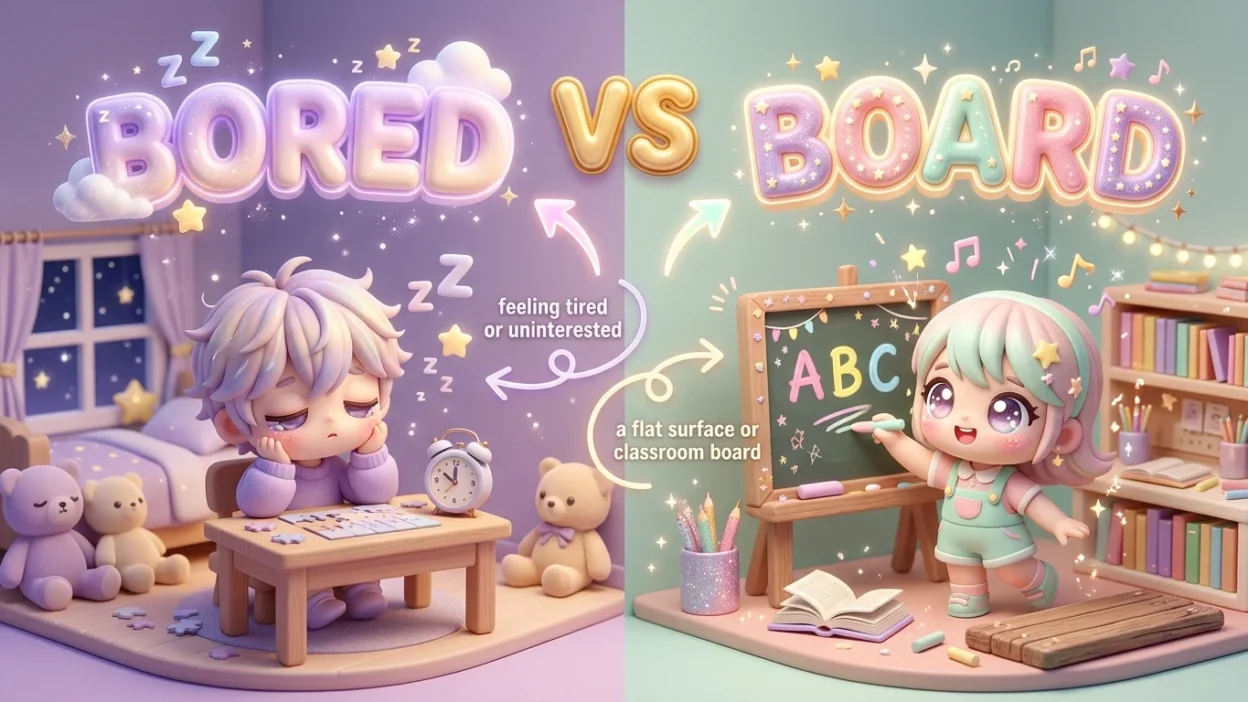
The words “bored” and “board” sound exactly the same, but they have completely different meanings. This can make them confusing, especially when you are writing a message, completing schoolwork, or learning English. You might say that you are bored during a long meeting, or you might write something on a board in your classroom. Both words sound alike, but using the wrong one can change the meaning of your sentence.
The easiest way to understand the difference is to remember that “bored” describes a feeling, while “board” usually refers to a flat surface, a group of people, or a type of material. In this guide, you will learn their meanings, spelling differences, grammar rules, and everyday examples so you can use both words correctly.
Quick Answer
“Bored” describes a feeling of having little interest or nothing enjoyable to do. “Board” is a noun that can mean a flat surface, a piece of wood, or a group of people who manage an organization. Both words have the same pronunciation, but their meanings and spellings are different.
Why People Confuse Bored and Board
People confuse “bored” and “board” because they are homophones. This means they sound the same when spoken but have different spellings and meanings.
Their pronunciation is nearly identical, so you cannot always know which word someone means just by hearing it.
For example:
- I am bored. (I feel uninterested.)
- I wrote it on the board. (A writing surface.)
The surrounding words in a sentence help you understand which meaning is intended.
What Does Bored Mean?
Bored is an adjective that describes a person who feels uninterested, tired of an activity, or unhappy because there is nothing exciting to do.
It often describes a lack of interest or mental engagement.
Examples of Bored
- I feel bored at home.
- She was bored during the meeting.
- The children became bored after lunch.
- He gets bored when he has nothing to do.
- Are you bored with this movie?
Remember: Use “bored” when you are talking about a feeling of having little interest or excitement.
What Does Board Mean?
Board is a noun with several meanings. It can refer to a flat surface used for writing, a piece of wood, or a group of people who make decisions for an organization.
It can also appear in expressions such as “boarding a plane” and “board games.”
Examples of Board
- The teacher wrote the answer on the board.
- We bought a wooden board for the project.
- The school board held a meeting.
- The children played a board game.
- Passengers began to board the plane.
Remember: Use “board” when referring to a surface, group, object, or the action of getting onto a vehicle.
Bored vs Board: Comparison Table
| Feature | Bored | Board |
|---|---|---|
| Meaning | Feeling uninterested | A surface, group, or object |
| Word type | Adjective | Usually a noun; also a verb |
| Pronunciation | Same as board | Same as bored |
| Spelling | Ends in -ed | Ends in -ard |
| Common use | Feelings and emotions | Writing surfaces, groups, travel |
| Example | I am bored. | Write it on the board. |
When to Use Each
When to Use Bored
Use “bored” when describing how someone feels because an activity is not interesting or there is little to do.
It is common in conversations, messages, stories, and everyday writing.
Examples:
- I am bored with this game.
- My brother feels bored at home.
- She looked bored during the lesson.
- We got bored while waiting.
- The movie made me feel bored.
When to Use Board
Use “board” when referring to a physical surface, an organization, or getting onto a form of transportation.
Examples:
- Please clean the whiteboard.
- The board approved the new plan.
- We need a wooden board for this shelf.
- The passengers will board the train soon.
- They played a board game together.
12 Examples of Bored vs Board
Here are some simple examples to help you understand how each word works.
| Bored | Board |
|---|---|
| I am bored today. | The teacher cleaned the board. |
| She feels bored at school. | He wrote his name on the board. |
| We were bored during the trip. | The board held an important meeting. |
| The children look bored. | They played a board game. |
| He gets bored easily. | The wooden board is heavy. |
| I was bored with the show. | We need a new notice board. |
| Are you bored right now? | Please board the bus carefully. |
| They seemed bored at dinner. | The board approved the proposal. |
| My sister is bored at home. | The passengers will board the flight. |
| I get bored without music. | Put the books on the board. |
| The students were bored. | The school board made a decision. |
| He felt bored during the lecture. | She bought a cutting board. |
Common Mistakes to Avoid
Here are some common mistakes people make when using these words.
- Mistake: I am board at home.
- Correct: I am bored at home.
- Mistake: Write your answer on the bored.
- Correct: Write your answer on the board.
- Mistake: The students were board during class.
- Correct: The students were bored during class.
- Mistake: I bought a wooden bored.
- Correct: I bought a wooden board.
- Mistake: We played a bored game.
- Correct: We played a board game.
Always check the meaning of your sentence before choosing the spelling.
Easy Memory Trick
Here is a simple trick to remember the difference:
Bored = Feeling.
Board = Object or group.
Think of the letter E in “bored” as standing for “emotion.” It describes how someone feels.
Think of “board” as something you can write on, build with, or use in a game.
Examples:
- I am bored. (A feeling)
- I wrote on the board. (A surface)
This little trick can help you remember the correct spelling.
American vs British English
There is no spelling or meaning difference between “bored” and “board” in American and British English.
Both varieties use the same words in the same way.
Examples:
- American English: I am bored with this lesson.
- British English: I am bored with this lesson.
- American English: Write your name on the board.
- British English: Write your name on the board.
The pronunciation may vary slightly depending on a speaker’s accent, but the words remain homophones in standard English.
Similar Words
Here are some other English homophones that sound alike but have different meanings.
| Word 1 | Word 2 | Difference |
|---|---|---|
| Sea | See | Ocean / Look |
| Their | There | Belonging to them / A place |
| Right | Write | Correct / Put words on paper |
| Pair | Pear | Two things / A fruit |
| Flour | Flower | Baking ingredient / Plant |
| Knight | Night | A medieval warrior / Darkness |
| Brake | Break | Stop a vehicle / Damage or separate |
| Buy | By | Purchase / Near or through |
Learning these word pairs can help you improve your spelling and vocabulary.
Final Verdict
“Bored” and “board” sound the same, but their meanings are completely different. Use “bored” when describing a feeling of having little interest or excitement. Use “board” when talking about a flat surface, a group of people, or getting onto a vehicle. Remembering that one describes a feeling and the other usually names a thing will help you avoid mistakes.
Frequently Asked Questions
Is bored or board correct?
Both words are correct, but they have different meanings. “Bored” describes a feeling, while “board” refers to a surface, group, or object.
Are bored and board homophones?
Yes. They are homophones because they have the same pronunciation but different spellings and meanings.
What does bored mean?
“Bored” means feeling uninterested, tired of an activity, or having nothing enjoyable to do.
What does board mean?
“Board” can mean a flat surface, a wooden piece, a group of people who manage an organization, or the action of getting onto a vehicle.
Is it I am bored or I am board?
The correct expression is “I am bored.” You are describing a feeling of having little interest or excitement.
What is a board game?
A board game is a game played on a flat surface or board, often using pieces, cards, or dice. Examples include chess and checkers.
Why do bored and board sound the same?
English has many words with different spellings and meanings but identical pronunciations. These words are called homophones.
Remember This
- Bored: A feeling of being uninterested.
- Board: A flat surface, wooden piece, or group of people.
- Board: Can also mean getting onto a plane, train, or bus.
- Homophones: Words that sound alike but have different meanings and spellings.
If you are describing your feelings, use “bored.” If you are talking about an object or group, use “board.”
Conclusion
Although “bored” and “board” sound exactly alike, they are used in very different situations. “Bored” describes how someone feels when they are not interested or entertained. “Board” usually refers to a physical surface, a group of people, or something connected to transportation and games.
The easiest way to remember the difference is to connect “bored” with emotions and “board” with objects or groups. Once you understand this simple rule, you can use both words confidently in conversations, schoolwork, and everyday writing.

Emmett Everett is an experienced SEO author dedicated to producing well-researched digital content that informs and inspires readers. His expertise includes keyword optimization, content strategy, and creating articles designed for lasting organic growth. He values clarity, accuracy, and authenticity in every piece he writes. Emmett continuously follows industry trends to ensure his work remains relevant and impactful.